About TEMPORALAW
Recent years have seen a rising tide of domestic and international climate litigation, including particularly cases based on human and constitutional rights. The resulting cases are divisive, with detractors arguing that courts cannot be used to seek legal or social change, including changes to climate policy. These arguments imply that it is “too soon” for these kinds of changes, for example because they claim that action is not sufficiently urgent; that risks of individual impacts have not been demonstrated with sufficient temporal proximity; that legal solutions can be sought later on; and that change through law should be incremental.
These ideas, like many of the key notions involved in legal responses to climate change, all have one thing in common: they are inherently ideas about time. Together, they can deeply impact the law’s response to climate change. That is because, when it comes to climate change and its impacts on human rights, there is agreement among litigants, leading courts and climate scientists that there is no time left to wait for future solutions. The factor of time is accordingly key in designing legal responses to climate change. Temporal issues shape engagement with the past, the present and the future of anthropocentric climate change, and raise fundamental questions about legal interpretation, the perceived universality of linear legal time, and the barriers to legal change.
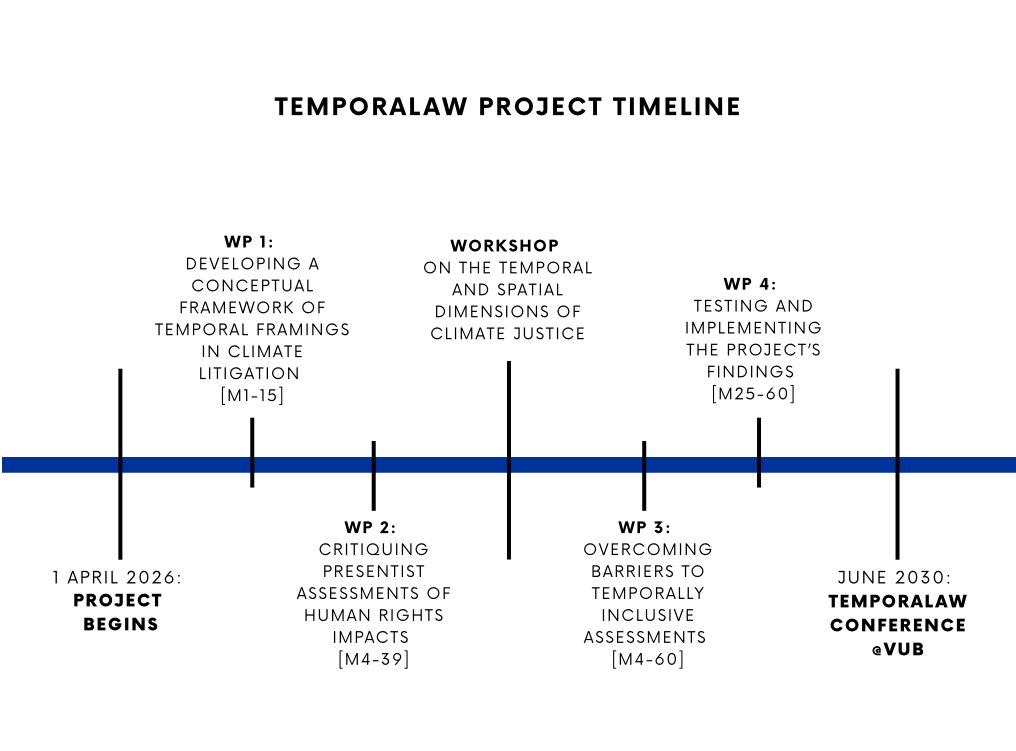
To examine how the law’s temporality can rise to the challenges posed by climate change, the TEMPORALAW project will identify and analyse the temporal assumptions underlying human rights law, and the law more generally, as exemplified through climate litigation. By making these assumptions explicit, applying a critical perspective and identifying alternative temporal perspectives, the project produces new ideas about central issues such as the possibilities and limits of the law, its treatment of scientific evidence, historical responsibility for emissions, and the protection of current and future generations. Over the course of five years (April 2026 – April 2031), the project team will apply critical-comparative and socio-legal perspectives to the dynamic phenomenon of climate litigation to produce insights about the law’s temporality.
 TEMPORALAW research project @ VUB